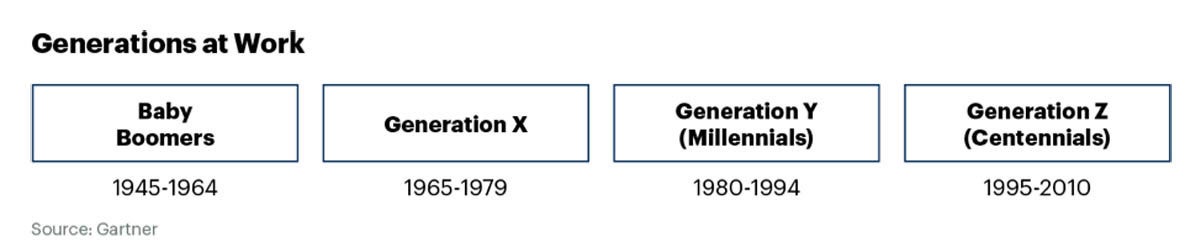
During difficult times, such as the current COVID-19 pandemic, friction between generations can become more prevalent and visible. Misperceptions about colleagues’ dedication to work are multiplied by natural anxiety in times of distress, leading to a culture of blame when things go wrong. Yet, now more than ever, it is essential for IT leaders and employees of all ages to work together to create a more resilient organization.
In order to achieve true integration and collaboration, it is important to recognize and leverage the different attributes of each generation, rather than attempting to homogenize the workforce. This will help build an IT organization that is inclusive and encouraging for all. CIOs can follow a four-step framework to gradually break the sociological barriers and stereotypes among generations and improve the department’s overall resilience.
Gartner
Lean on the younger generations’ quest for purpose
Everyone needs a reason to get out of bed each morning, but Millennials and Gen Z exhibit a more explicit need for a sense of purpose, particularly in their work. These generations have a lower tolerance than their Baby Boomer and Gen X counterparts for work that they do not consider meaningful.
Tap into Gen Z’s desire for a career development plan
A distinctive characteristic of members of Gen Z is the need to have a career development plan from their first day in the workforce. They plan their professional career strategically, versus the more tactical approach of the other generations.
Often, managers overlook or downplay the importance of a career development plan, which may end up causing demotivation and high turnover in Gen Z employees. Some IT organizations don’t have defined career paths across all roles, especially for lower-lever technician or service desk positions. The natural uncertainty of our current environment does not help either.
CIOs can tap into Gen Z’s desire for a career development plan and work with them to develop a “power-SWOT” chart — a SWOT analysis embedded in a two-axis matrix, formed by the gradient of the importance of initiatives for the overall IT strategy and a gradient of their complexity. To-be-done activities are listed in their corresponding box.

Gartner
Then, form cross-generational teams to tackle the medium-high initiatives. This activity will serve a dual purpose: It will allow Gen Zers to visualize the learning opportunities they will have in the IT organization in the short- and mid-term, and it will help create diverse teams to take on the most relevant challenges. These teams do not need to execute upon the activities in the power-SWOT in this step — that will come later on.
Create options that suit preferred work-life combinations
Work-life balance is one of the most divisive aspects between the oldest and youngest generations. On average, Baby Boomers and Gen X prefer working in an office. Millennials prefer a community-like working environment, but still make a clear distinction between their private life and work. However, Gen Z prefers to actually integrate their private and work life, without a sharp distinction between the two.
Some leaders may stop at thinking that as long as the work gets done, there is no right or wrong way to do so. However, it is paramount that CIOs facilitate an intergenerational understanding of these different interpretations of work-life balance. Otherwise, prejudices about dedication to work will relentlessly lead to a culture of blame when things go wrong.
Arrange a focus group with a sample of employees from each generation. Open a discussion about where they feel more comfortable working, when, and how they suggest that their performance be measured. For example, one group may prefer to work in the office during office hours; some may prefer to work partly in the office and partly at home; others may prefer working from home and be subject to stringent individual objectives. This will tap into the concept of what fair work-life balance (or integration) means for each generation. Now, as businesses are considering what a post-COVID return to the office will look like, is a particularly good time to have these conversations and to partner with HR to create options that match the workforce to their preferred working styles.
Leverage key areas of expertise for inter-generational collaboration
This final step is when IT leaders should expose the generations to working together on the plan derived from the power-SWOT analysis. Use mentoring and reverse mentoring for each power-SWOT activity, spreading knowledge from the savvier generation for that activity to inform the less savvy.
For example, Gen Z can mentor Baby Boomers and Gen X on initiatives that require usage of new technology, such as troubleshooting issues with a new VPN service or changing collaboration application settings in the shift to remote work. Gen X and Millennials can help Gen Z with initiatives that require expertise in interpersonal communication, like de-escalating conflicts among team members or appropriately responding when a company executive approaches the service desk with a complaint.
Taking this four-step approach, CIOs can steadily encourage intergenerational communication and collaboration. This will help to build a resilient IT organization with a workforce that is poised to succeed through the challenging times ahead.
Credit: Daniel Sanchez-Reina, Cristina Von Mayer, Gartner,