

Then 32 helicopters lifted off in a single formation, and the world took notice.
Thirty-two helicopters sat on the tarmac at Simmons Army Airfield, rotors still. The pilots had run simulations for weeks. They had studied wind patterns, mapped civilian airspace corridors, and calculated the precise spacing required to keep rotor wash from collapsing into turbulence.
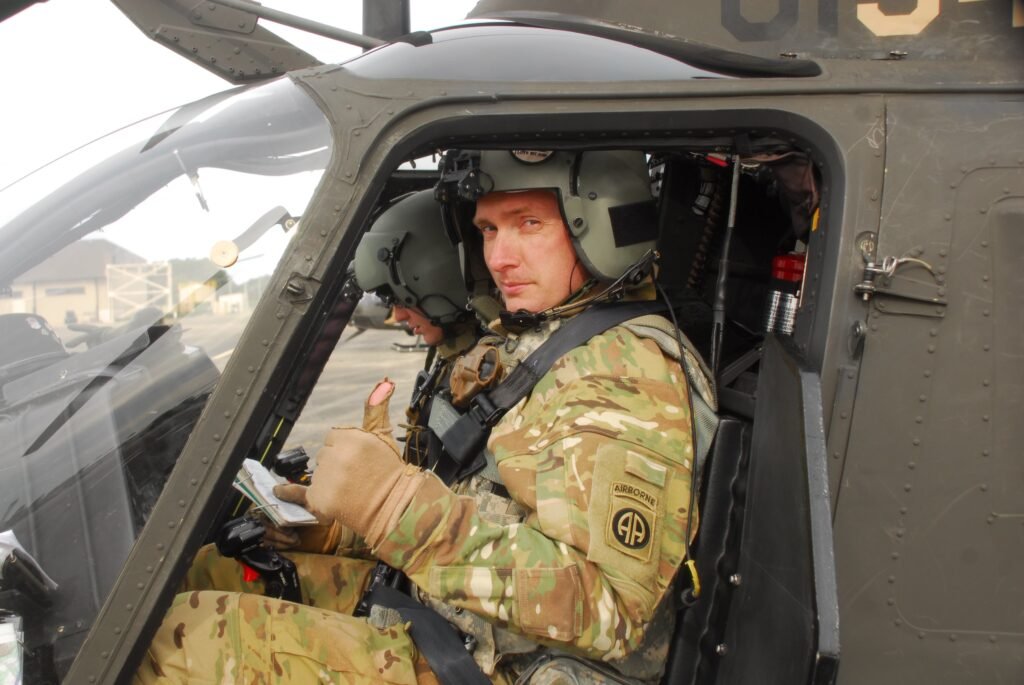
The morning of April 15, 2016, the Kiowa Warrior helicopters lifted off in sequence. Within minutes, they formed a staggered arc over Fort Bragg and the city of Fayetteville, North Carolina. Each aircraft held position through constant adjustments, throttle, collective, cyclic, while pilots watched the blades of the helicopter ahead. A single error could ripple through the formation.
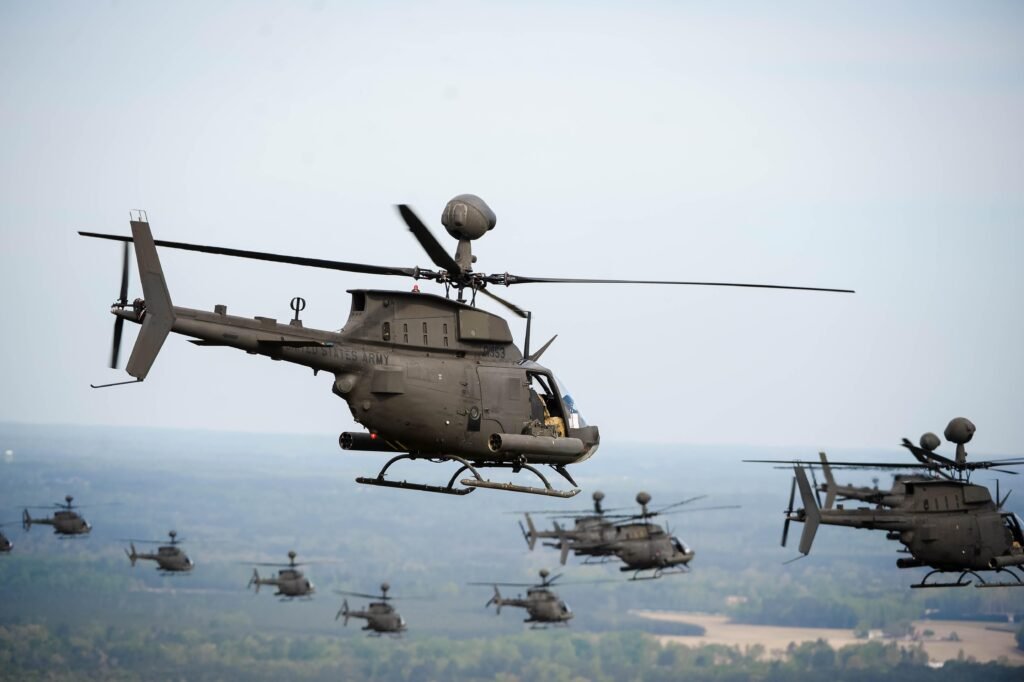
From the ground, the flyover looked like a choreographed display. What the public did not see was the coordination behind it: air traffic controllers managing military and civilian airspace simultaneously, pre-flight briefings that ran for days, the hundreds of personnel who made sure thirty-two aircraft could occupy the same sky without incident.
The 32-Helicopter Flight That Guinness Certified
Guinness World Records later certified the flight as the largest helicopter formation in history. According to the official Guinness World Records entry, the organization confirmed the number of aircraft, the location, and the participating unit: the 1st Squadron, 17th Cavalry Regiment, operating under the 82nd Combat Aviation Brigade.
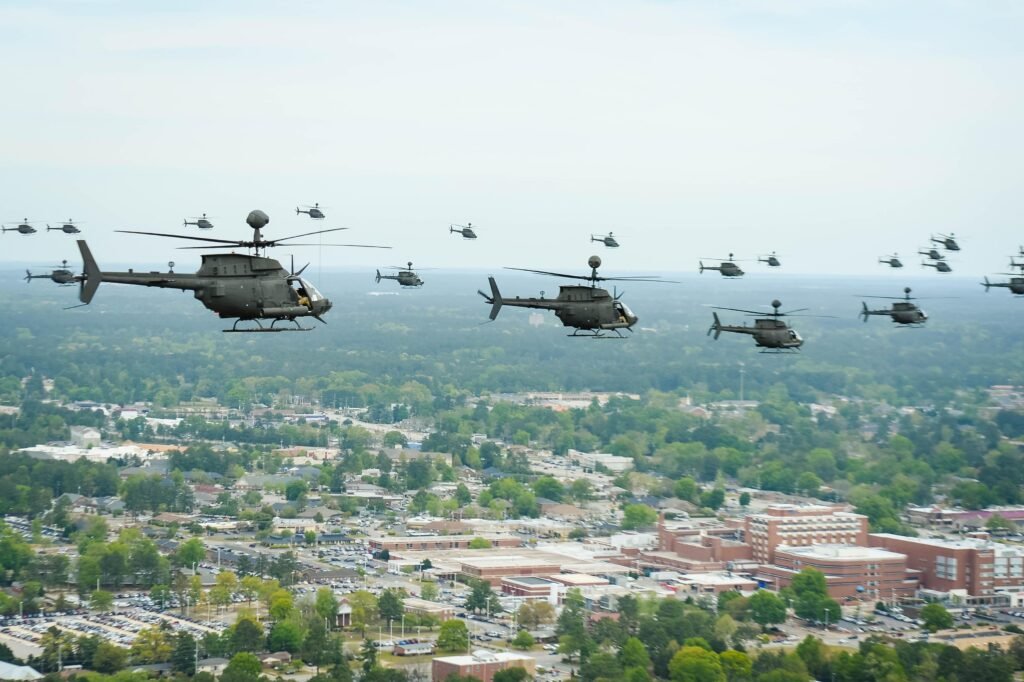
The purpose was to pay homage to all who had served in a Kiowa Warrior organization. It was the final flight of the OH-58D (R) Kiowa Warrior fleet within the U.S. military, as the aircraft were being retired. Coverage from Military Times described the flight as a public farewell to surrounding communities, performed with intensity typically reserved for combat readiness exercises.
But the record has not gone uncontested. Former pilots and air traffic controllers have described larger formations they claim to have witnessed decades earlier. One commenter said they controlled a flight of 153 mixed rotary-wing aircraft at Simmons Army Airfield between 1993 and 1995. Another recalled being number 25 in a 50-helicopter formation during REFORGER exercises in Germany in 1971. A third described more than 90 helicopters at a British Army Air Corps airshow at Middle Wallop in the 1980s or 1990s.
None of those claims have been verified by Guinness World Records. But they reflect a persistent undercurrent among aviation veterans who see the 2016 flight as a significant achievement, but not an unprecedented one.
What Made the Kiowa Warrior So Hard to Replace
The OH-58D Kiowa Warrior was not a heavy attack helicopter. It was developed for armed reconnaissance, providing forward observers with direct visual confirmation, laser guidance, and light strike capability. It thrived in combat zones where speed, silence, and altitude control gave it a tactical edge. The aircraft lacked cutting-edge sensors, but it delivered reliability and mission focus.
Under the Army Aviation Restructure Initiative, the platform was phased out to consolidate resources and modernize the rotary fleet. The Army anticipated that Apache helicopters and unmanned aerial systems would take on the Kiowa’s roles. In practice, neither platform fully matched its agility.
The Apache’s heavy armament and higher profile limit its performance where stealth and maneuverability are critical. Drones require stable communication links and remote piloting infrastructure, and often face delays in dynamic battlefield conditions.
Delays, Gaps, and a Quiet International Surge
After the Kiowa’s retirement, the Army pursued a direct successor under the Future Attack Reconnaissance Aircraft program. Two prototypes—the Bell 360 Invictus and the Sikorsky Raider X—entered testing. But the program has stalled. Updated projections place operational fielding beyond fiscal year 2028.
That timeline has created a capability gap. Reports from field units reflect concerns about reduced situational awareness, slower target acquisition, and increased maintenance burdens. The Army continues to rely on interim solutions that stretch existing platforms beyond their original design parameters.
One analysis noted that the 2016 flight has become a cautionary benchmark for the risks of retiring a proven aircraft without a fully fielded successor. Meanwhile, other countries have moved in the opposite direction. Australia, South Korea, and Poland have acquired or upgraded light scout helicopters. Requests documented by the Defense Security Cooperation Agency highlight growing international demand for manned reconnaissance platforms.
Why a 2016 Flyover Still Appears in Army Classrooms
Nearly a decade later, the 32-helicopter flight remains the most ambitious rotary formation ever conducted by the U.S. Army. It is now referenced in leadership courses and aviation manuals as a real-world example of tightly integrated air operations under pressure. The event serves as a cautionary benchmark. Retiring a proven aircraft without a fully fielded successor has long-term implications, especially when the original platform filled a unique role.
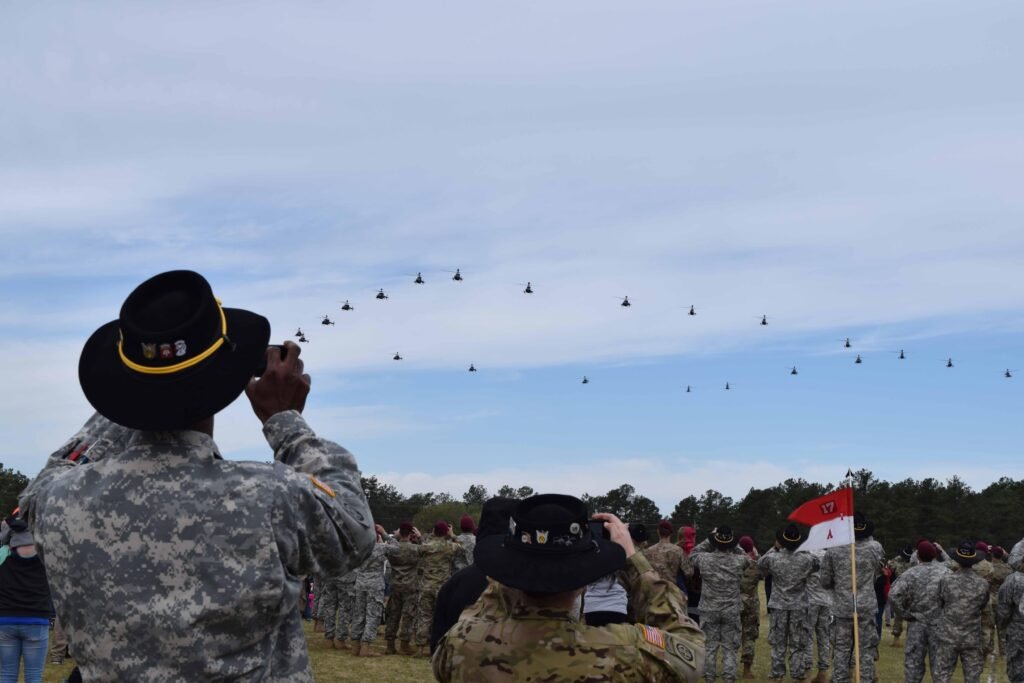
The Department of Defense released photographs showing helicopters flying in staggered, overlapping arcs—each held in place by pilots making constant adjustments against rotor wash and wind. Behind the display were hundreds of personnel coordinating air traffic across military and civilian airspace.
Efforts under the broader Future Vertical Lift initiative continue to evolve. Test programs are expanding, budgets have increased, and operational requirements are being refined. Still, no aircraft has emerged to match the Kiowa Warrior’s combination of responsiveness, endurance, and adaptability in the scout role.
For the pilots who flew that day, the mission was a farewell. For the Army, it has become a measure against which future reconnaissance aircraft will be judged. The record formation remains the largest officially documented helicopter flight of its kind.
Credit: Evelyn Hart, Indian Defence Reviews


 Emeka OBINNWA(http://emex-systems.com)